Select Page
Cutting Costs in Your Fashion Business!

Cutting Costs in Your Fashion Business!

Many of us often focus all our attention on increasing revenue and profits in our fashion businesses that sometimes we fail to realize that having a higher disposable income, i.e. more money to spend, is not only possible by increasing our cash inflow but also by reducing our expenses.  Simply put, cutting costs saves you money! And YES we know we need to cut costs but just have no clue how to go about it since everything we spend our money on seems vital to the business.  However, there is always a way… if you know how…
 
Today, I’ll draw your attention to an expense caption in the books that gulps so much of our money that if computed over a period can actually buy all the machinery we need and even pay salaries for the next 12 months! Any idea?

Yup!  PHONE BILLS!  Those things I hate to see at the end of each month and which makes my heart beat faster anytime I check my account balance.  Yeah.. this may be the happy face 😀 I have when talking to friends, family and customers but then it quickly turns to: 🙁  when I see my credit balance at the end of the month & when it’s time to pay my bills!  Yeah… not a happy time for me at all I tell you.  Thankfully I use a post-paid line else it would have been much worse!

Many people ask why I use a post paid line.  Well I ask how possible it is for an entrepreneur not to use a post paid or contract line.  The excuses I usually get when I advise people to get post-paid lines are “I will be unable to control myself” or “I would rather pay as I go along so that when I run out, I know I’m out and I do not run into debt”.  All I say is HA!  Like seriously?!  
 
I doubt a lot of people chat as much as I do.  Ask anyone who knows me and they will tell you that I can gist for state and country!  One of my most shocking moments was when I got banned from Facebook chat for reaching my chat limit.  Like really, who gets banned from FB chat?!  I didn’t even know there was any such thing as a FB chat limit.  BUT one thing I realized was that no matter how long my conversations last for, my bills are ridiculously reasonable in comparison with the costs I would have incurred if I was using a pay as you go line.  AND I have a chat limit.  Interestingly enough and contrary to what people think, I chat more when I have a positive balance and begin to watch how long I spend on the phone the minute I hit a negative balance since I do not want to get disconnected.  
 
And why do post paid lines make so much sense?!  I’ll tell you just now! 
 
1st, your bills are cut by half!  Ok forget the fact that you can’t make free midnight calls but seriously, why should you be calling people in the middle of the night anyway?!  
 
2nd, your phones do not go off in the middle of a conversation!  There is nothing more embarrassing and more unprofessional than telling your customer, “Sorry, I ran out of credit!”  Oh yah, I forgot.  Blame it on the network why don’t you?!
 
3rd, you have a credit limit.  Anyone in business or business school would tell you the best way to finance your business is to leverage on credit facilities to enable you have sufficient cash flow to run the business.  In other words, try to buy assets and raw materials on hire purchase or credit facilities where you buy now and pay later, or in instalments.  So if this can be done on assets, why not extend the same towards your phone bills and work towards paying the bills.
 
RECENTLY, I discovered an even amazing communication facility that cut my bills even further and no is not limited to post paid lines only!  I’m not even sure if it applies to post-paid lines.  Closed User Group (CUG)!  I actually knew about it like 2 years ago but never got round to getting one set up for my staff and I till like last month or so and it has been completely amazing!  And I tell you, this really is the way forward for business owners!  
 
On my current CUG plan, paying N1,000 a month for each of the 3 lines within the Group gives me 500 free minutes to talk to anyone within my CUG and reduces my call costs to those outside the Group to I think 25k per second as against 50k per second.  That’s about N12,500 worth of free phone calls and about N8,000 savings in my pocket for handing out more instructions over the phone 😀   And the best part is, you can add as many numbers to the CUG list and call your tailor, driver, accountant, marketer, you name it.  
 
AND even better!  At Oja Ara the other day, I discovered a company which offers CUG platforms on all networks at an even better deal.  With their CUG plan, you actually talk for free throughout the month!  @ least that’s what they told me!  I think many telecomms companies actually offer a CUG plan.  Now THAT’s what I’m talking about! 
 
So there you have it!  Be more efficient and get chatting for free!  You know what BT says… “It’s good to talk!”
 
Have a good day people!
 
PS.  Pictures culled from the internet
Words of Advice from a Seasoned Businesswoman…

Words of Advice from a Seasoned Businesswoman…

 
Yes I promised I’d do this AGES ago but somehow kept losing my interview sheet or something else always came up.  But today, though I had other stuff to write about, I thought it would be good to start off your week with an encouraging story from my major role model.  A story I grew up listening to but never quite appreciated it  until I became an entrepreneur.  A story that sort of corroborates my take on doing business without necessarily having lots of money.
 
Ok… here goes…


Meet Mrs Adebola Alanamu, my FABULOUS mother!  Yeah…. she’s a stunner right?!  Can…and will probably give me a run for my money anyday!  😉  She is one person I know who understands how to use overdrafts and the banking system to its fullest advantage.  I write her letters and I am amazed at how she is able to manipulate her finances in such a way that she is pretty much a don at her bank.
 
Anywayz… here’s her story…
 
“I had no money when I started business.  I was working in Nigerian Breweries Marketing Company, starved of promotion for about 3 – 4 years so I moved to Wema Board Estate Limited as an auditor.  As time went on, I felt it was time for me to leave as I had no help and had to stay at home with my young children.  But I was in a predicament.  I had to pay up my debt to the company and still had my children to feed.  But since my children came first, my mind was made up! 
 
Before I left the company, I had a side job where I was supplying cement and sand to build the Festac ’77.  I paid up my debt to the company with some of the money I had made from that venture and used the rest to take care of my kids while I was at home with them.  Of course the money ran out eventually.
 
One day, out of desperation, I thought to myself ‘let me meet my bank manager, maybe he can help’.  Mr Komolafe, still a living witness, listened to my ordeal, looked at me for a looooong time and approved a N2,000 overdraft.  With this N2,000, I continued to supply cement and sand and that’s how my business took off!  I worked hard, always paid my employees on time, saved diligently and never denied my children the necessities they needed.  And I never for once allowed myself to think about the fact that I was a graduate supplying sand!  
 
From there, my overdraft increased to N4,000 and then to N10,000 and before I knew it, my business expanded to include cement block making.  And from block making, I moved to the oil industry as the dealer of a petrol station of one of the major marketers.  
 
Same thing happened when I moved.  I needed to deposit N40,000 to Nolchem but I only had N25,000.  The person who promised to assist with the balance shattered my hopes on the eve of payment so I ran to my mother who loaned me the money and told me I must return the loan in 3 months since she had retired from selling ankara in the market.  And then again my business began and grew.  
 
I built my business with overdrafts and zero collateral.  And for those who believe everyone in the oil industry makes lots of money, that’s not true.  Only high turnovers make sense.  All I had was the determination to succeed, my major motivation being my children, building relationships and paying back my loans and overdrafts and that is what has sustained me till today.  I became such a good businesswoman that even my company then, National, became my guarantor at the bank when I was moved from one petrol station and was asked to be the dealer of their prime station that had just been built by Shell.
 
I look around me today and see so many proud yet lazy people.  There is nothing you cannot do to make money.  As you can see, I even sold sand! Even as I speak, I still sell pure water at my retail outlet and make at least N100,000 a month from it – AND I pay my taxes as at when due.  So many youths today are proud. They need to make ends meet YET they feel insulted when you give them options.  For me, it’s not necessarily what you sell but how you sell it and more importantly, how you treat your customers.  With diligence, hard work and steadfastness, you can achieve a lot and you need to be motivated.  My major aim was to educate my children to whatever level they wished to go and still live a comfortable life.  This I have done as a single mother.
 
I have been in business since 1978 and I am still in business.  So I count myself as a very successful businesswoman!”
 
😀  Yup so do I.  Not easy bringing up 5 kids pretty much all by yourself for a substantial part of their lives but she did it and I must say she did a mighty great job of it as well.  After all, look how I turned out 😀 (LOL)!  But seriously, she was really strict!  We used to fear her a lot but now we love her to bits!  Thank goodness she’s really chilled out now!  Goodness… she never spared the whip at all!  I still remember that electric wire rubber, we called “rubber” she used to flog us with! Now I look back and I’m thankful she did only some of and not all she did though I must confess, I understand why now.  She did what she had to.  Her story was much longer but I edited it to capture the important points.  
 
So what’s the moral of the story?!  I’m sure it’s pretty obvious.  Be encouraged, be determined and remain focused!
 
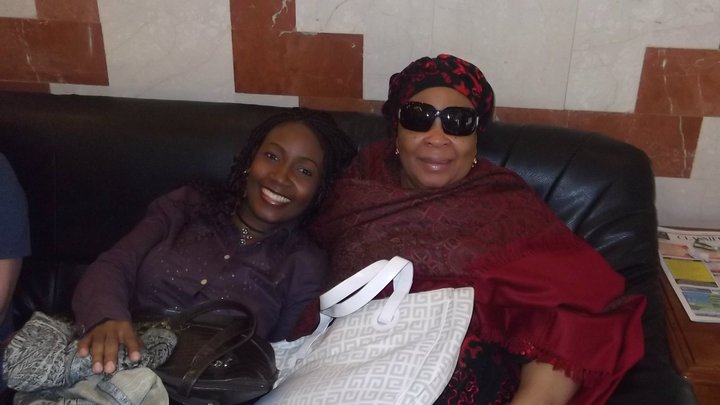
I leave you to enjoy pictures of my mom and I.  Yup, she is always with me every step of the way!  And y’all shouldn’t ask why I’m dark either.  People keep asking me like I’m supposed to know why I chose my dad’s complexion. 
 
  
                @ my graduation from fashion school in Cape Town        @ Lagos Fashion Week, April 2010
              
On a business trip to Dubai which also coincided with my bday last yr  & in her office last year, on her birthday wearing an outfit I made for her.

Anywayz, have a great week everyone!

Cheers!

Giving Up Is Not an Option!

Giving Up Is Not an Option!

Taken from a friend’s BB display picture
I woke up this morning to the following BB broadcast…

“I was raped at the age of 9” – Oprah Winfrey
“I didn’t even complete my university education” – Bill Gates
“In my childhood days, I stitched shoes” – Abraham Lincoln
“I struggled academically throughout elementary school” – Ben Carson
“I used to serve tea at a shop to support my football training” – Lionel Messi
“I used to sleep on the floor in friends’ rooms, returning Coke bottles for food money, and getting weekly free meals at a local temple” – Steve Jobs
“My teachers used to call me a failure” – Tony Blair
“I was a 3rd class graduate in my first university” – Prof Wole Soyinka

… And the popular story “GEJ had neither shoes nor a school bag!”

Wake Up Peeps! What’s your story? Is it an excuse for failure? The Lord be with you.  J.Okene (JP)”

These are famous people we all know and look up to and need we even talk about the Abiolas and the owner of Coscharis Motors (who never went to school).  But truth is we all have our own success stories and no we may not be popular yet, we are still an inspiration to ourselves and others and should continue to be.  We need to inspire ourselves to continue to “keep keeping on no matter what”.

When I read the BB broadcast, I immediately added 3 more to the list.  Here goes:


“I sold sand and cement to pay off my loan to the company and feed my children when I made up my mind to resign from paid employment since I never got promoted” – Mrs Adebola Alanamu, Dealer, Conoil Service Station (my mother) – I promised I would tell you her story…. and I will very soon…

“I used to walk for miles to school without shoes” – Adewale Ajayi, Partner, Tax, Regulatory & People Services, KPMG Professional Services (my mentor).

“I used to wake up at 5am and drive for at least an hour (to and fro) everyday to pick up a girl and drop her off at school every morning before she resumed at 8am and I still had to be at school by 9am else I’d get kicked out of school if I didn’t meet my 80% attendance.  Why did I do this?  I needed money to complete my various final projects and graduate collection to enable me graduate from Fashion School” – Temitope Williams. – Yup… that was my story!  In fact, I did so many odd jobs not necessarily to make ends meet but to maintain a certain lifestyle and I was determined never to work as a waitress!

So yes!  You and I have our various stories.  And it is what keeps us going everyday.  Someone told me that people only get inspired by stories of popular people who made it.  I beg to differ.  I am inspired by normal people who have achieved a lot… regardless of whether they are celebrities or normal people.  It’s the stories I count.  And it is even more believable when you see and speak to these people everyday!  It makes you believe in yourself!

I went through enough challenges in South Africa and almost quit fashion school when my friend died but I kept at it, of course with lots of support and encouragement.   When I also felt like giving up as a young business owner, I kept at it.  Not because I had a point to prove to myself (by then I was at my lowest ebb and didn’t really care anymore) but simply because I didn’t want to disappoint those who believed in me.  And now, it seems my hard work is finally paying off!

So what’s the moral of my story?!  You may be going through enough issues now with your fashion business.  And you feel like giving up.  I talk to people going through challenges all the time and who have either given up or are on the verge of doing so and I try to encourage them to keep at it.  And forget what others say…. only giving up totally makes you a loser.  Giving up on a certain perceived route to success does not!  It simply means you need to backtrack and carve out another route for yourself and try to do things differently.  

And know this!  As long as you have life and God, it is not over until it’s over!  Make positive confessions and surround yourself with people who have your genuine interests at heart.  Keep at it and it will eventually pay off! 

Enjoy the rest of your evening…

Cheers!
So tell me… Do You Know Who You Really Are as a Fashion Designer?!

So tell me… Do You Know Who You Really Are as a Fashion Designer?!


Simple enough question right?! I thought so too… but after relating to a few people, I decided to write a post on this topic to get designers to actually start looking deep within to discover who they really are as designers and what their design aesthetic is.
 
Let me take you back to a conversation I was having with a friend sometime last week.
 
He was firmly of the opinion that designers needed to start with market segmentation and identify their markets first before coming up with their designs. His explanation was simple enough. “You need to know what the market wants before you design”. I told him point blank that I did not agree with him! That logic may work in other industries but not in the creative industries and definitely not in the fashion industry!
 
My reason?
 
Yes it may make sense from a theoretical point of view but identifying your market before knowing who you are as a designer and what your design aesthetic is is like pulling the cart before the horse. You will be unable to sustain it in the long run!
 
As a fashion designer and this of course applies to those who plan to build careers in the industry or become fashion entrepreneurs, you need to have a design signature. You need to know what you can do, what you like to do, what comes naturally to you, what your vision is for the person you would like to dress and of course, who your ideal customer is. You do not go out looking for the customers first and then decide to come up with designs to suit that customer! I mean who does that?! Ok so what happens if all the market wants is “high fashion” as is usually the case over here and all you really want to focus on is lingerie or even sportswear? Would you go out of your way to continue creating “high fashion” when you know deep down what you want to do is totally different? I tell you and I may have said it before… “there is nothing worse than loving what you do and not enjoying it!”
 
I remember when I completed my studies, people told me that the market wanted ankara and made-to-measure clothing. I knew first, I did not want to work with ankara for so many reasons or go down the bespoke route. I had nothing against the fabric or sewing for people. It simply was not the vision I had… or should I say it simply was not something I wanted to constitute a substantial proportion of my business. BUT did I listen to people? Yes. Did I dabble into an area I didn’t have much passion for or expertise in? Yes. Did I get burnt? YES!
 
I also remember when magazines wanted my work or people wanted me to participate in fashion shows, I kept getting requests for “high fashion” clothing…and I quote… “never before seen, unique items” (whatever that means) or “Lady Gaga-ish clothes”. I told the people… sorry… I do not do high fashion. It is simply not me as a designer. That is not to say I cannot come up with something if I wanted to… but I would assume the reason for putting my clothes in magazines and on the runway is for publicity and also to make sales. I didn’t see the point if I did not plan to replicate those clothes for anyone who liked them and wanted to order them. So for me, I felt it was better to channel all my energy into the areas I knew I wanted to specialize in.
 
So what am I saying?! …and this is my personal opinion…
 
I believe that as a designer, you have to search deep within, determine what you like create, you decide (not the market or a consultant) who your ideal customer is and most importantly focus on the vision you have for your passion and business.
 
Once you are absolutely sure of what your mission is, then go out to look for your target customer. Conduct adequate research, TEST your designs for feedback from your intended market and then tweak your designs to suit what your market wants…because after all, you do have to sell your designs to make a living. But the truth is… there will always be a market. But detailed research is key! Conducting your research can simply be asking as many people as you can if they will buy your designs and what changes they would like. If you are targeting a middle class market and your designs are too expensive for them, look for ways of cutting down costs such as alternative fabric choices, minimize details without losing the very essence of the design, cheaper production techniques and the likes.
 
Do not let people drag you into bespoke clothing simply because they feel that is where the market is if all you want to do is retail or vice versa. Do not let people force you into menswear when all you want to do is womenswear. Do not let the market force you into selling fabrics if all you want to do is design. Now that is not to say you cannot set up parallel businesses for these different areas if you have the capacity… but my point is… know what you want to do and do not get swept by the tide. If you dabble in an area you are not comfortable with, you run the risk of either not having the ability to continue to churn out creative designs suitable for that area (well except you employ a designer) or have the capacity to continue to produce such highly detailed work. If you choose to operate outside your comfort zone, do it when you are ready and not out of desperation else you will be frustrated!
 
And most importantly, surround yourself with the right people. Seek advice from people who understand your industry and who will not merely give you theories that should work in the “ideal” world. And even if they do not have an in-depth knowledge of your industry, do not let them change the vision you have for your business. I have come across many people who have tried to make me change my vision but thankfully I remained firmly rooted in my beliefs and I think it is paying off…at least even if nothing else, I am happier now…
 
SO
 
I challenge you to go into a quiet place (or noisy place if you so please), say a prayer asking God to help you with this journey of self discovery, pick a pencil and a piece of paper or your journal, draw the very first sketch that comes to your mind and write down 10 things about your abilities as a designer (what you like to do, what comes easily to you, what details you like to put in your clothes, if you want to sew for people or go retail, menswear or womenswear, lingerie or maternity wear, who your ideal customer is, etc), try and describe your design aesthetic or principles in 3 words and finally write down the vision you have for yourself. Be true to yourself.
 
Do this 2 or 3 times or as often as you can and when you are firmly rooted in your convictions, then start to write a life plan for your fashion business, even if it is a mere hobby or a serious business. When you complete this task, discuss it with someone, could be a family member or a mentor. If you have no-one or need help with this task, feel free to send me an e-mail on xxaaviere@gmail.com and I will be glad to assist.
 
Looking forward to hearing from you!
 
Have a pleasant week!
 
Cheers!
 
There really is A WHOLE LOT MORE to fashion than mere sewing…

There really is A WHOLE LOT MORE to fashion than mere sewing…

 
True that! This picture just gives a snapshot of the different areas a designer can choose to focus on without necessarily engaging in bespoke wear. These are the different areas I have dabbled in in the past and some of these pictures are samples of my work (though I only provided the clothes for the shoot in the last picture). But yes I have even done a bit of fashion styling, photography and hair & make-up even though they fall outside my area of expertise. But really, a designer should really be an all-rounder since we are responsible for creating the vision. We are the catalysts that set the ball rolling for the other areas of the industry and seeing we cannot be a jack of all trades, we have to outsource certain parts of the design process to other professionals in the field.
Now why do I feel so strongly about this topic? Because I’ve been getting an earful from people on how I am “wasting my skills” simply because I decided to stop sewing for people. Sometimes I wonder if “not sewing for people” translates to “not providing clothing to my target market” or worse, makes me any less of a designer. Ok, perhaps I should say this here. I do plan to provide clothing to people but I have chosen to focus on a retail market rather than a bespoke market. And no I am not totally abandoning bespoke, it will just constitute a tiny part of my portfolio.
 
I recall a conversation I was having with a friend 2 nights ago. We were catching up on each other’s businesses when she says “Oh I need you to make something for me”. And my response was: “No sorry I can’t. I don’t make clothes for people”. Then there came the all-too-familiar pause I get from people when I make this statement and then the all-too-familiar question… Ok… so if you are not sewing, then what are you using your fashion skills for?
 
And that is the same question I get asked over and over again.
 
Truth is there is so much more to the Fashion Industry than the usual “cut and sew” we do in Nigeria and I mean this in no disrespectful way whatsoever. When I tell people that most design students I engaged with in South Africa actually wanted to be buyers than designers, I get a blank look. But oh, how can they understand what I’m talking about when no such job description exists in this environment. Well except for the owner of a boutique who goes abroad to buy her stock…which is a form of “buying” in its own way.
 
BUT my point is too many people in Nigeria view fashion strictly from a “bespoke” or “made to measure” perspective. They believe you MUST sew if you claim you are a fashion designer. In fact, too many designers in Nigeria have been led to believe, either from pressure or circumstances, that the only way to survive in the Nigerian Fashion Industry is to necessarily make clothes for people but I beg to differ! What about boutiques and stockists? Would one say they are not part of the Industry simply because they do not create the clothes they sell? Does that make them any less successful than people who sew?
Take me for example. When I came back from Fashion School, I knew the areas of fashion I wanted to focus on. I knew it had to be Fashion Retail rather than Bespoke Clothing simply because I did not have the patience for bespoke. But of course, people felt I had to operate in the “ankara” and “aso-ebi” market, which necessarily meant bespoke clothing. Of course there was a lot of money to be made in that segment of the market but I knew that was so not what I wanted to do. I just wanted to create my designs in standard sizes and produce them for the mass market.
 
But just so I was not regarded as one who never listened to advice, I got involved in that area for a bit all in a bid to make money and satisfy people but got severely burnt! Staying up till 4am at the sewing machine was not my cup of tea and I decided in July this year it had to stop even if it meant not earning revenue for a while so I could properly plan my business and strategies. I tell you this people, there is nothing worse than loving what you do and not enjoying it.
 
Now should a designer sew his/her garments or run their own production unit? Well what I say is if there is a business case for it and you can get someone with high quality control standards, then sure why not?! But really, the task of a designer is really to create a concept and get people that can help her realize her vision. A designer needs to work with a design team to assist with the concept and a marketing team who can ensure that these products get to the target market. Of course, she needs to create the clothes and that is where production is. But she does not necessarily have to produce the clothes. This can be outsourced to a competent production factory, which, unfortunately in our environment, is comprised mostly by the local tailors, and ensure the clothes are produced to her satisfaction.
 
Look at the major players in the global fashion industry vis-a-vis why China is a force to be reckoned with in the world today. When I speak to people, I ask them how many global designers actually produce their own clothes. I challenge you to pick up one of your shirts right now and take a look at the label. More often than not, you will find “Made in Bangladesh” or “Made in China” or made in some other Asian company. I believe designers over here need to collaborate more with each other to get this Industry to where it should be.
 
When people tell me there is mass unemployment, I tell them well people just don’t want to work. If people really needed jobs, all they had to do was target a designer and collaborate with her and she will be smiling to the bank. The typical designer is overworked in this environment. In fact, people can earn a living while in school as designers are constantly looking for assistance. There are so many areas particularly with production such as pattern making, that people can make money from. Just look at companies like Butterick and McCalls who have made so much money simply from creating patterns.
 
I think our environment needs a complete reorientation and designers need to take themselves more seriously if we want other industries to take us seriously. Fashion Design is an art and it really is no different from Architecture. We, designers, need to let people realize that and the sooner we start to put certain structures in place and make people realize than we are a whole lot more than mere machinists, the more respect we will get and the easier life will be for all of us.